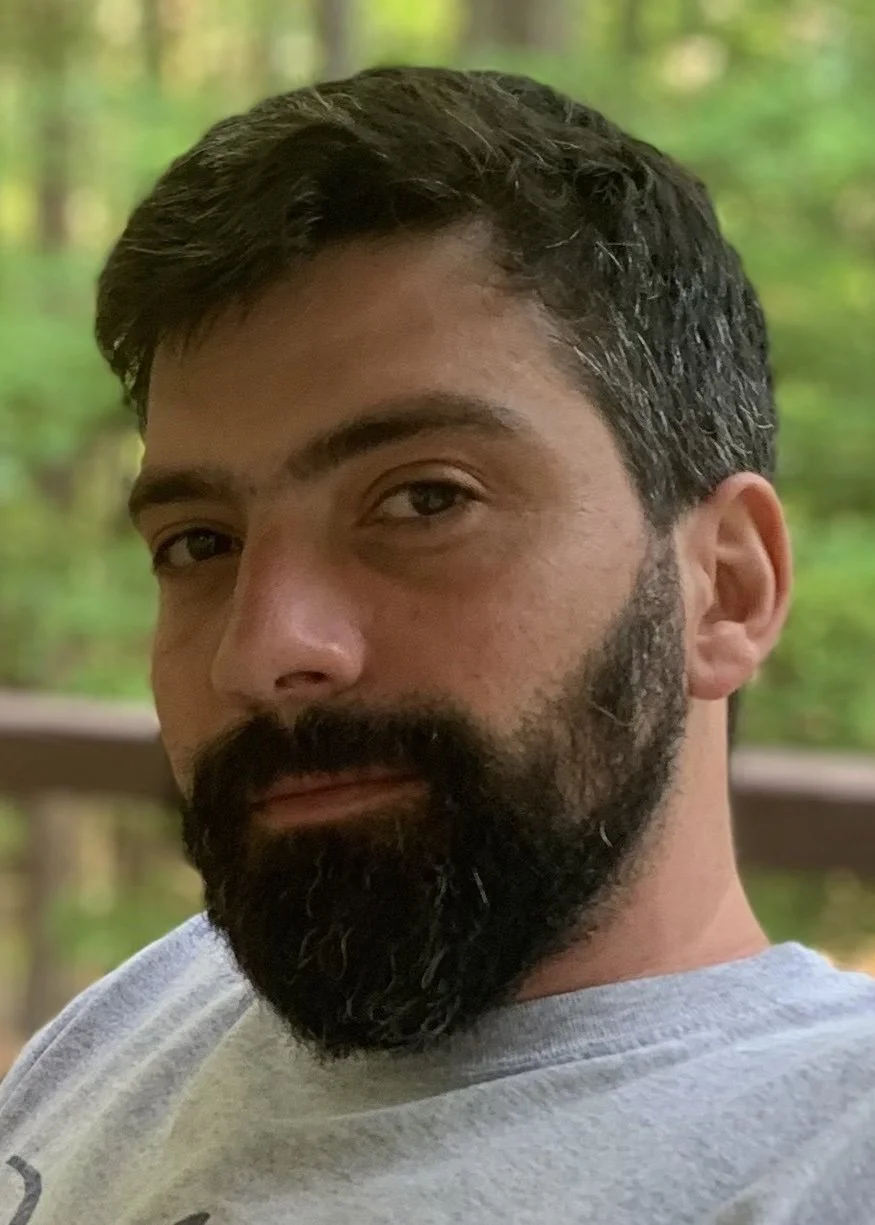
In this interview, Felipe De Brigard, Professor of Philosophy, Psychology and Neuroscience, Faculty member of the Center for Cognitive Neuroscience, and Associate of the Duke Initiative for Science & Society, talks about growing up among and learning to live with, bombs, kidnappings and conflicts in Colombia during the time of Pablo Escobar, Catholicism, Dungeons and Dragons, aspirations to become a priest, hormones, Nietzsche, theater, Descartes, attending the National University of Colombia, memory and Aristotle, applying to and being rejected from 10 grad schools, how Adrian Cussins helped him get into Tufts, Fodor, beer pong, Dennett, and working at the Danish Pastry House, contemplating going to grad school for neuroscience and getting into UNC philosophy, the differences between public and private universities, working with Prinz, Knobe, Lycan, Dorit Bar-On, and eventually Kelly Giovanello in the psychology department, the sometimes contentious relationship between philosophy and science, a comforting conversation with Patricia Churchland, the philosophy and psychology of memory, joining Dan Schacter’s Cognitive Neuroscience of Memory Lab at Harvard, Duke, the experience machine, the Memory and Forgiveness Project, and his last meal…
[4/8/2026]
What was your earliest memory?
I am a fan of memory, so this one is an easy one. I must have been three years old. I had one of those old toddler beds that had cylindrical, vertical beams, and I remember that I was able to rotate a couple of them, ever so slightly, to pop them out of their sockets so I could create a gap large enough for my big head and my little body to squeeze through, at night, and play with my toys. I have a couple of very clear memories of me doing so. Thankfully, I don’t remember the expression on my mom’s face when she realized, later at night, that I wasn’t in my bed.
Where did you grow up?
I grew up in Bogotá, Colombia, and moved to the US when I was 22.
What was growing up in Colombia like?
It was a difficult place to grow up in. It was the time of Pablo Escobar, the drug cartels, the bombs, the kidnappings. And then, in the 1990s and early 2000s, the conflict with the guerrillas and the paramilitaries was at its worst. It was very dangerous.
Of course, I was a child so only later on was I able to contextualize many of my childhood memories. It was when I grew up that I recognized that the apparently unprovoked crying of my classmate was because his father had been kidnapped for months, or that the sudden absence of another one was due to the unexpected funeral of a family member that was killed by one of the bombs. But the violence and the sense of danger was omnipresent, and most of us who grew up in Bogotá—in Colombia, really—at that time have lots of stories to tell about how close we were to one bomb or another, whether the windows or walls in our homes were affected by the blast wave, or how many people we knew that were kidnapped or killed by some violent actor or another. My siblings often talked about the fact that doing homework at a friend’s house was always a risk; in the time of landlines, you didn’t want to be away from home if a bomb exploded. Communications would be interrupted and inevitably you’d think the worst, and often those expectations would materialize. And for at least three years—1989 to 1992, I’d say—it felt like there were bombings every week. I was a teenager when the violence between the guerrillas, the paramilitaries, and the army basically sieged us inside the city, as going anywhere outside urban areas was extraordinarily dangerous. I liked hiking in natural parks and rural areas—I still do—but every time I left Bogotá, I knew I was risking being kidnapped or murdered.
Did I worry? Probably, but there is a point in which you stop doing it. It is part of life.
Colombia is also a beautiful and happy country, and my compatriots have a kind of resilience that is almost magical. Additionally, I grew up with a wonderful family—I am the youngest, by a long shot, of 5 siblings—and was profoundly and overtly loved by all the members of my family. For me, my family was, and continues to be, always a safe place.
What did your parents do, and what was your family like? Rich? Poor?
My mom was an elementary school teacher and my dad, well, it’s complicated. He wanted to be a Catholic priest and went to the seminary. However, shortly before he was ordained, he was told to leave. The reason I was told is that my father was deaf. Apparently, some bishop or cardinal or what have you decided that since he was deaf, he was unable to fulfill many of the duties priests have toward their congregations—confession, I remember being used as a reason. We are talking about the Catholic Church in Bogotá in the 1950s. So, he enrolled at the National University, in the newly created department of chemistry (I think it was called “pharmacology” back then), but since my grandfather died, he left his studies having completed only a couple of semesters. Neither of my parents finished college—although my mother did complete at some point some sort of certificate in pedagogy that allowed her to become a school teacher.
We definitely weren’t rich—though, interestingly, we were perceived as such, because my last name, as well as my mom’s last name, were from families that traditionally had money. But I also never felt poor—my oldest brother does talk about times, prior to me being born, that were hard, when my mom had to pawn jewelry and things like that to make ends meet. But by the time I was 10 or so, my oldest two siblings were out of the house, married and working, and the other two, while still at home (although not for long), were also working. I wasn’t a child that grew up with money, but I also didn’t grow up with unmet needs.
Religious household?
Very much so. Both my parents were Catholic, I went to a Catholic school, and I actually was profoundly religious—even considered becoming a priest myself—until perhaps my second semester in college. Philosophy made me change my mind.
Academic?
Yes and no. My dad read a lot, and had lots of interests in history, philosophy, theology, the Bible, and science—definitively science—in a way that he was able to beautifully reconcile with his very religious outlook on life. My mom loved teaching and cared about her students in ways that I can only dream to emulate. So, my father was definitely erudite and loved to learn and my mother was a pedagogical prodigy; I am completely sure I inherited from her my love for teaching and mentoring.
As a little kid, what were you interested in?
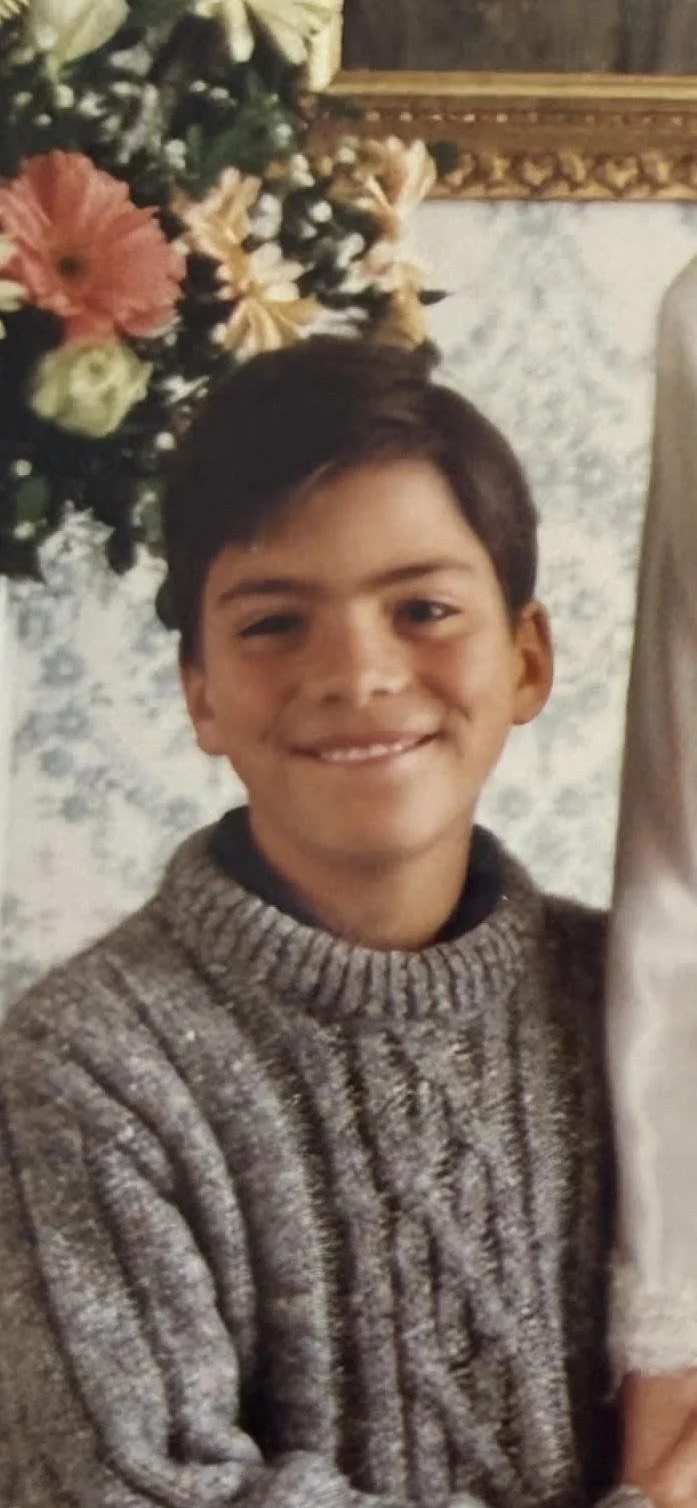
Not sports. I was small and utterly unskilled. At everything. Now, when you are Colombian, I guess you are supposed to have an innate ability to play soccer and dance salsa. I didn’t inherit the first gene. And then I went to a school where soccer was a religion. My sheer lack of eye-foot coordination made me immediately an unintentional apostate. So, I read, voraciously. I read everything I could put my hands on. As a pre-teen, the school psychologist mentioned to my mother that I probably had some kind of attention/hyperactivity disorder, which my mother interpreted as a call to arms to get me tired. So, she enrolled me in all sorts of extra-curricular activities: piano, chess, the Boy Scouts, drama club, you named it. I was exhausted at the end of the day. And, of course, I also discovered Dungeons and Dragons. I’ve been playing on and off, since I was 12.
How were you similar to, and different from, the rest of your friends and family?
I think in many ways I am very similar to my siblings. As I mentioned, they are older than me—my oldest brother is almost 20 years older than me, while my other brother is 10 years older—and I looked up to all of them. My oldest brother and my middle sister, for instance, have always been voracious readers as well and both are very intellectual. They know art, music, literature, history. I always have wanted to be like them. My oldest sister was less intellectual but astonishingly brilliant. She was an extraordinarily successful lawyer and had a fantastic capacity to synthesize a complex issue and to articulate it with enviable clarity. I miss her brilliant mind every day. I love fantasy so does my brother who is 10 years older than me. In fact, we played D&D together for a few years, until he moved to Canada. He’s way more creative and artistic that I’ll ever be, though. As for my friends, I didn’t have too many growing up—not at least until I went to college—but the few friends I had were drama or D&D nerds like me. So, not too dissimilar—except, perhaps, they were all taller and much better at soccer than me.
Earlier you mentioned you wanted to be a priest when you grew up?
I was an altar boy at the local church, and all through middle and high school I belonged to a religious group—kind of a “high school club”—that taught catechism to very poor children and prepared them for their first communion. The group also collected money and food and distributed them among very poor families in the north of Bogotá. We worked very closely with social workers, and we really tried to help people very much in need. I was very active in that group and even became the president in my last year in high school.
I was under the impression that being a religious person and being an ethically good person were correlated. Since striving to be a good person has been such an important part of my life since my childhood, I thought the path was obvious. Once the hormones kicked in and celibacy started to look a bit less appealing, I began to explore other options.
Did you dig high school?
No. I hated it. I was constantly bullied. By everyone. Even the bullied bullied me. I was physically very small basically until college and, as I mentioned, I went to a boys only Catholic school where not being good at soccer was seen as some kind of genetic abnormality. Instead, during break time I’d go to a bench to read poetry, Nietzsche or the Bible. I mean—which prototypical high school bully wouldn’t want to punch that!? So, no. I hated it. I always feel that I got an education in spite of, rather than thanks to, my high school.
Favorite classes? Extracurriculars?
Literature, History and Chemistry were by far my favorite subjects in high school. Also, in Colombia philosophy is mandatory in the last two years of high school, and I liked those classes. Actually, I liked those teachers. Philosophy seemed a bit useless, but it was definitely a lot of fun and somehow seemed to fulfill a role in my mental life that nothing else was occupying. As for extracurriculars, I spent a lot of time doing theatre. Even joined the Colombian Theatre Corporation while I was in high school and during my first year in college. I was a terrible actor but loved writing scripts and the feeling of rehearsing and performing. What you feel when the final curtain closes in front of you, after a flawless performance on opening night, when the scenario darkens and the heavy sighs of your fellow actors around you are quickly eclipsed by the roaring clapping of the audience, is indescribably exhilarating.
So, what did you do for fun? Get in trouble?
The school I went to was private and my mom could only afford it because I was on a very generous scholarship that required me to have a very high GPA. If my GPA fell below a certain average, I would have lost my scholarship, so I was very studious. I really didn’t get into trouble, in the traditional sense. Now, I was also a very active kid and I was dumb, so I was very prone to, er, accidents, that would put me in the ER with some regularity, such as getting hit in the eye by a rock because I convinced my friend down the road that it was fine to pretend it was a baseball, or my attempts to show, at age 5 or 6, that if you run through a glass door at a certain speed and at particular angle, you may be invulnerable (you are not; I have the scars). So, yes, I guess I got into trouble, but not cool trouble. Mostly, dumb trouble.
Any sign you'd be a philosopher? Where did you apply to college and why?
I liked my philosophy classes and loved to read. I really liked literature, history and theology, and I had a serious interest in helping people. Now, in Colombia, unlike the US, you don’t apply to a college and then decide what your major is going to be. Instead, in your last year of high school, you apply directly to a particular department in order to enroll in a particular major. In a way, you are supposed to know what you want your profession to be when you are 17 or 18. Now, military service was also mandatory for men between high school and college. And often what happened is that, in your last year of college, you applied to a particular program and, if you get in, they’d hold your spot for one year until you were done with your military service. So, once I decided that I wasn’t going to go to the seminary—and now that I think about it, both my brothers-in-law helped me a lot during this time, when I was trying to make my mind—I decided to apply to the medical school in this one, private university. I knew by then that I was going to be drafted, so I made arrangements so that they would hold my spot for a year.
However—and, please, to the young fellows that may be reading this, this is the opposite of career advice—one night, at a party, a friend of mine and I dared each other to get accepted at the National University. Unlike every other university, which accepted your grades and the Colombian equivalent of the SAT, called ICFES, the National University had its own admission exam, and it was famously very difficult. I registered for the exam but, when I did, I applied to the philosophy department, in part because I knew I didn’t dislike philosophy, and in part because I thought it would be easier than the admissions exam for medicine. Besides, since I was going to the army for a year, I figured it wouldn’t matter. The main point of the whole maneuver was to win a bet. Now, long story short, I was admitted to the philosophy department and, for various reasons—including the fact that I had just turned 17 when I was recruited by the army—I was discharged as I arrived. Since my admission at the medical school had been deferred, I found myself with a year to spare, so I decided to attend the National University just for kicks. The first semester studying Wittgenstein, Aristotle and, especially, Descartes, completely changed my life. I never left philosophy since.
You mention being drafted. Explain!
It is nothing too exciting, I am afraid. In Colombia, as in a few other countries, there was mandatory military service (I think now it is non-mandatory). As long as you were healthy, whether you got drafted or not was basically a random matter. Back when I was drafted, it literally involved drawing a ball from an urn. What I discovered, though, is that not everyone that was drafted, ended up serving. When I had to present to the battalion, there were more people than available spots, so they used a minor medical issue I had back then, which wouldn’t have saved me prior to the draft, as an excuse to discharge me earlier.
What impressed you about Aristotle, Wittgenstein, and Descartes?
I came to Aristotle through Plato and always tend to read them as offering two contrasting views on truth and knowledge. Plato—and his mouthpiece Socrates—taught us that truth is unattainable, that these silly human bodies our souls are trapped in make it impossible to appreciate things for what they really are, but that searching for truth and knowledge is a pleasant and noble endeavor, so we should enjoy the ride! By contrast, I feel that for Aristotle, the process of inquiry was troubling, and that mental solace was only reached when truth and knowledge were attained. Scholars of Greek philosophy would probably disagree with my reading, but to this day, I like to think of them as representing this sort of back-and-forth between doubt and certainty, which is kind of how I feel I live my life as a philosopher and as a scientist. Also, it is worth mentioning that Aristotle has been a huge influence in my way of thinking about several issues in philosophy of mind—particularly about memory. In fact, my most recent book “Memory and Remembering” is, in a sense, an homage to Aristotle’s “On Memory and Reminiscence”, which I think anticipates many of the central issues in contemporary philosophy of memory.
My love for Descartes was different. During my first semester in college, we read a bunch of Descartes—but not the typical stuff you read in intro to philosophy in the US. We actually read his treatises on The World and The Man, as well as his work on optics, the meteors and geometry. For me, Descartes was primarily a scientist who, reluctantly, had to offer a dualist “non-solution” to the mind-body problem because he couldn’t figure out a mechanistic way out. Again, scholars would likely disagree with me, but I don’t think Descartes was very happy with his dualism, and I like to believe that had there been no Inquisition and better neuroscience, he would have been a materialist.
I like that take. Wonder what contemporary dualists would say. What about W?
My relationship with Wittgenstein is complicated. In college, I was an avid Wittgensteinian. I read basically everything written by Wittgenstein—including stuff that I am not sure he’d have liked to see published, like his personal diary. Some of my favorite teachers loved Wittgenstein as well, and he was regarded by many in the department as a genius that killed analytic philosophy, and the philosopher that anticipated the impossibility of a science of the mind. I, too, became convinced that Wittgenstein’s thoughts in, for instance, Philosophical Investigations or Zettel, were simply unobjectionable kernels of brilliance, and often found myself, just as my teachers did, ending arguments with a single Wittgensteinian verdict: ‘Neuroscience won’t tell us anything about the mind—I’d proudly declare, for instance—because “explanation must come to an end somewhere”!’ But as I grew older, my fascination with Wittgenstein waned, as I realized that his work was very thin in terms of arguments (e.g., why should explanations stop at behavior?), and that the seemingly authoritative force of his ideas came less from Wittgenstein’s work and more from scholars of Wittgenstein, devoting their lives trying fill the gaps between his meandering aphorisms.
You joked earlier that hormones may have influenced your decision to not pursue life in the church, but you also suggested philosophy may have also influenced your decision.
Philosophy was critical, of course, but the seed was already planted. I have a vivid memory of a conversation with my father, walking back from mass on a Sunday evening, when I asked him about heaven and eternity. I must have been 12 or 13 years old, and I was petrified with the idea of living forever. I was also terrified with the idea of being bored. I told my dad that I was worried that, if I was to go to heaven, I was going to get bored at some point. My dad told me not to worry, that God would have an infinite amount of board games and books for me to enjoy for all eternity. But, I insisted, there is only a certain number of variations of board games and story plots before they become repetitive, and then they will be boring. ‘We are talking about eternity, here!’. So, my dad told me that I shouldn’t worry about that either, for God was going to change my mind in such a way that I wouldn’t get bored again. ‘But if God changes my mind’, I replied, ‘then the person in heaven wouldn’t be me!’.
As I grew up, those conversations became more frequent and the worries more pressing. I recall another one, as an older teenager, in which my very patient father declared that maybe, just maybe, I didn’t have the “gift of faith”. I hated that response, of course, for it seemed silly to me that the solution of a question about the dogma required me to believe in the dogma to begin with. Of course, in college, I learned that this very same strategy was followed by the Catholic church in the Middle Ages to “solve” perennial questions about their dogma, such as the problem of evil. The credo ut intelligam—I believe to understand—associated with Anselm and many other medieval philosophers, did not sit well with me, and I quickly began to think of Catholicism as a sort of “asylum of ignorance”, to use Spinoza’s poetic trope.
A second, major influence in my religious conversion was the Euthyphro. The way in which Plato presents the dilemma about the nature of morality and the authority of the gods, crystallized something that as a teenager I struggled with a lot: the fact that many religious and pious people—particularly Catholic priests but also deacons and nuns—behaved in ways that were profoundly and undeniably immoral. Plato opened my eyes to the fact that religion and morality need not correlate, that more often than not they pull in opposite directions, and that it makes perfect sense to be a morally good person and an atheist.
What did you do for fun, and how did you evolve as a person?
In college I finally made wonderful friends. We used to cook together, go dancing, to the movies, etc. I am still in touch with many of them, and we have remained close since.
Inspirational classes or teachers?
A few, yes. I really liked one of my philosophy of mind teachers—Juan José Botero—from whom I learned a lot about the intersection between phenomenology, philosophy of mind and cognitive science and neuroscience. I also really enjoyed learning from Douglas Niño, who is a Peirce scholar—in fact, one of the philosophers that knows the most about Peirce and American Pragmatism that I’ve ever met. But my biggest influence, without a doubt, was my neuropsychology teacher, Dr. Patricia Montañés, from whom I learned an enormous amount about the brain and neuropsychology. I worked with her for most of my undergraduate degree, and we actually co-wrote a book together: an introductory textbook to clinic and cognitive neuropsychology.
Challenges in college?
There were a few. I had to juggle school and work. During my first four semesters in college, I also worked as the editorial assistant for Ideas y Valores, the Colombian Journal of Philosophy, and then, once I started my third year, I worked part time as a high-school teacher. I was already thinking of applying to graduate school outside of Colombia, so I knew I needed to save money, and fast. Plus, the money situation at home wasn’t great, so having the extra income was always welcomed. Also, the conflict between the guerrillas, the paramilitaries and the army was at its worst.
Explain. What was going on?
In the early 2000s, a new right-wing president was elected after running on a militaristic platform against the guerrilla. As a result, the internal war got much worse in rural areas and, unsurprisingly, there was zero interest in funding science or education. Many young college students in my generation saw very little opportunity to continue an academic or scientific career in Colombia, so trying to leave the country was basically the only option we saw then to continue our education.
What did your parents make of this decision?
My parents were very supportive. I think my dad was very happy I went to the Universidad Nacional, which is the public university he spent a couple of semesters in after the seminary, and I think my mom was a bit weary of my desire to not pursue medicine and to stay in philosophy instead. But they never questioned my decision, and they always supported me.
Did you ever consider doing anything else?
Definitively. I think that if I hadn’t been drafted for the military service, and if I hadn’t asked for deferment at the medical school, I probably would have become a medical doctor. I think my fascination with brains and with the mind would have emerged no matter what, so I might’ve ended up in some adjacent field, such as neurology or psychiatry.
If you could go back in time, and give yourself advice back then, what would it be?
I’d tell myself to start learning English earlier on. When I started college, my English was very poor, almost non-existent. I only got serious about learning English half-way through college, and by the time I moved to the US, I was still struggling with the language. I’ve been living here for almost 25 years, and I still feel that I occasionally struggle.
When did you decide to go to grad school? Where did you want to go and why? Receive any guidance on that front?
It was in 2001. In Colombia, most undergraduate degrees take 5 years to complete—sometimes more—but I was trying to finish mine in 4. By about my second year in college I knew I wanted to pursue graduate studies, and that I wanted to continue learning about the relationship between the mind and the brain. Cognitive neuroscience was non-existent in Colombia back then, so I thought I had two options: either to continue a clinical career in neuropsychology or to pursue a degree in philosophy of mind at an empirically oriented philosophy department. Despite my profound love for neuropsychology, I realized half-way through my college training that I didn’t want to become a clinician. I was much more interested in the theory than in the practice of neuropsychology. So, I thought the second alternative was going to be better for me. But, as I mentioned, my English wasn’t that great back then, and I also had no idea how to even apply to grad schools in the US. Internet was barely available, and I had very little guidance. I gathered as much money as I could to apply to some PhD programs I knew had, in their faculty, philosophers of mind I had read, and went for it. I think I applied to 8 or maybe 10 places. I was rejected from all of them.
I was disheartened, not only because I didn’t get in, but also because I had spent my little free time applying rather than finishing my degree. So, I started my fifth year in college, hoping to finish and re-apply. But then, something wonderful happened: a new professor of Philosophy called Adrian Cussins had recently moved to Bogota, and the university where he was teaching was looking for an interpreter; someone who could translate his lectures in real time for the students. I was then working really hard to improve my English, and since I had read some philosophy of language and philosophy of mind, I was able to get the job. That year working with Adrian changed my life. Not only because I was able to do philosophy in English for the very first time, but also because he taught me that being a philosopher was more than merely commenting or regurgitating what “famous” philosophers had said: you could actually question their views, even challenge them! He showed me, for the first time, that it was possible for me to become a philosopher, and not simply a commentator or a scholar of philosophy, which is what I was trained to be when in college. Adrian also helped me to revise my writing sample and wrote the letter of recommendation that, I am sure, was responsible for getting me into the master’s program at Tufts.
Awesome. What was your writing sample on?
My first writing sample, the one I submitted when I was applying the first time to grad school and was rejected across the board, was on Fodor’s language of thought. The following year, when I applied to grad school for the second time, I changed writing samples and used a paper on Peirce. Believe it or not, I read a lot of Peirce when I was in college. I honestly believe he was the last systematic philosopher, and probably one of the greatest American minds. I haven’t worked on Peirce since, but there is a very special place in my heart for his ideas. Maybe one day I’ll return to his work.
Totally. I had a Pierce period too. But it’s been years since I’ve read his stuff. I mostly remember being intensely into it. Was the move to Tufts easy? Any time for fun?
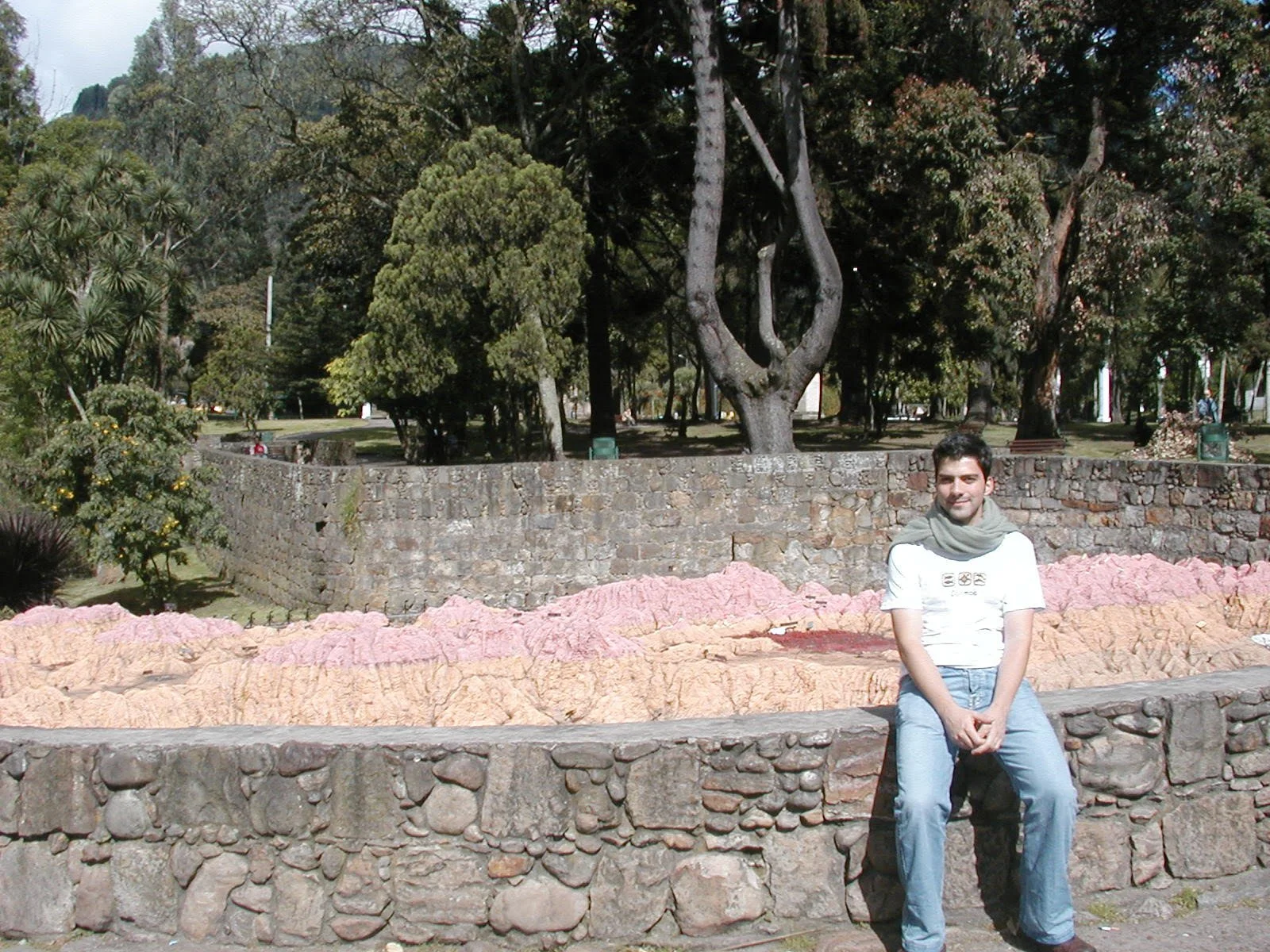
It was great in certain respects but difficult in others. Tufts was a huge change relative to my undergraduate institution. My first shock was the money. Many students were very rich—I had never seen as much wealth in my life as I saw there. The classes were amazing, my classmates brilliant, and the many talks and events around campus were always inspiring and thought-provoking. But the cultural change was really hard for me. I came from a culture that is very warm, where people hug, and kiss and have no problem touching each other. Friendship and love are incarnated and expressed not only through our words but through our bodies as well. Boston was completely different. People are comparatively cold and distant. They are nice, of course, but it’s a rather aloof camaraderie. It took me a long time to adjust to it. I remember so vividly one of the first times I rode the T, and noticed how, when the cars were crowded, people would adopt the strangest postures so as not to touch each other.
There were other cultural shocks that were hard too. In the US people are always proud of being busy. That was never a point of pride for anyone I knew growing up. They were proud of achievements, or spending time with friends and family, but not for having too much work. Also, people plan everything in the US. If you want to have lunch with a friend or a colleague, you must schedule it. In Colombia we are much more spontaneous. You don’t plan. You just do. Parties were also weird. First of all, I don’t think I had ever been to a so-called party in which there was no music and no dancing until I moved to the US. Second, the drinking. I had no idea what a drinking game was until I moved to Tufts. I remember this one “party”—square quotes are intentional—in which I was asked to bring a six-pack. Then some sort of drinking game started in which people were vying for shots of liquor by throwing a ping-pong ball into a distant red plastic cup. I didn’t know you had to earn your drinks in American parties! Since I had brought a six-pack, I was happy to suggest to some of the guests that, if they wanted, they didn’t need to compete for the beer. “I’ll be happy to give you one!”. Eventually, you get used to the cultural differences, but the first year in the US was quite an adjustment for me.
What was trending philosophically in the philosophy department, and in general, at the time?
Tufts was an interesting place to do philosophy, and definitively the best place for me to be brought up to speed with the way philosophy was done in the US. First of all, I learned that analytic philosophers don’t read anything prior to 1880 at best. Maybe the occasional reference to Hume, and that’s it. I remember how, in my first semester at Tufts, I took an intro to epistemology with Jody Azzouni (who, incidentally, is probably the best philosophy teacher I’ve ever had, and one who influenced my own philosophical views in important ways) where we read Gettier’s famous little paper. I had read that paper before, in college, in a class entirely dedicated to Plato’s Theaetetus, where we learned how Socrates dismisses the view of knowledge as justified true belief (Burnyeat, if I recall correctly, makes the connection between the two quite explicitly). But many of my classmates took the view of knowledge as JTB as if it was really the received view by the time Gettier wrote the paper, and I couldn’t help but think “Received by whom? Haven’t people read Plato?” Maybe I am wrong, but among many philosophers I encountered when I first moved to the US, there is almost an ahistoric reading of philosophy, as if nothing of interest to contemporary problems happened prior to the 1900s. It is baffling.
That being said, precisely because I had come from a very continental and historically oriented undergraduate program, I didn’t know much about many contemporary philosophers. Quine was huge at Tufts. I read a lot of Quine back then and really liked his work—even if later I’ve come to reject some of his views I used to like, such as his naturalized epistemology, for instance. I also read quite a bit of Russell and, for the first time in my life, David Lewis, whom I don’t think was ever mentioned when I was in college. I learned an enormous amount at Tufts.
Who did you work with? What was the thesis on?
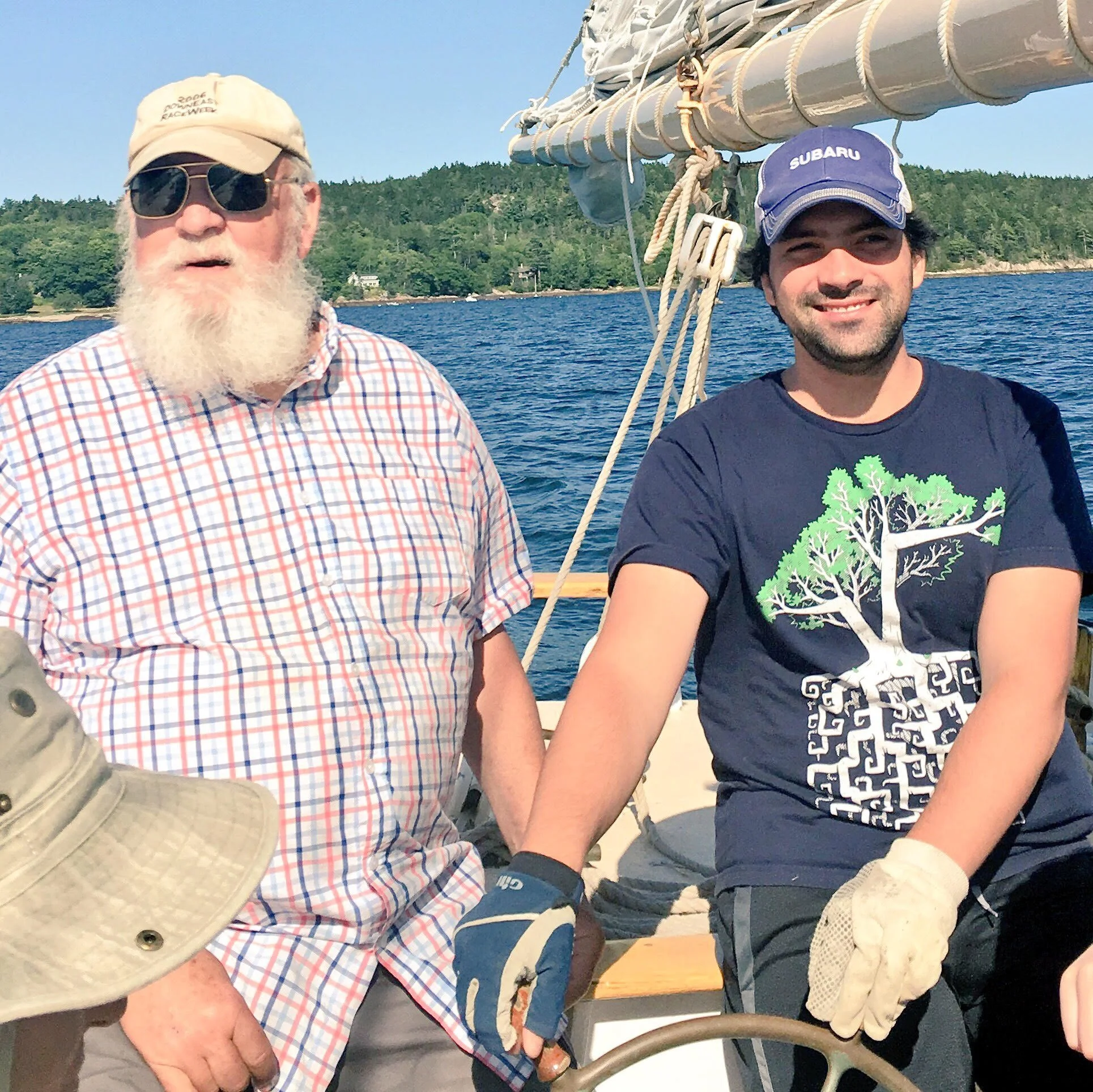
I worked with Dan Dennett, who remained my biggest support and academic advisor for the rest of his life. He was by far the most important positive academic and professional influence of my career, and someone to whom I ended up being very close. I eventually became, as he would say, “an honorary family member”, and I miss him dearly. Now, Tufts didn’t have a “thesis” at the time in which I did my MA—I don’t know if they have one now. What they had, was four (!) comprehensive exams that were famously hard: one in metaphysics, one in epistemology, one in ethics and moral theory, and a fourth one of your choosing—which I took in philosophy of mind. However, we were encouraged to take our best final paper from one of our classes and to revise it thoroughly in order use it as a writing sample for our PhD applications. I had two candidate papers. The first one was a paper I wrote for Azzouni’s philosophy of science class, which was based on two of his books “Knowledge and Reference in Empirical Science” and “Deflating Existential Consequence”. I loved those books, and they left a big mark on my way of thinking about scientific theories and about the way theoretical terms refer to their purported targets. My paper sought to bring many of Azzouni’s insights into the realm of cognitive neuroscience. The second paper I wrote for Dennett’s philosophy of mind class, and it was a criticism of Searle’s biological naturalism. I ended up using that second paper as my writing sample, after multiple drafts that Dan, patiently, helped me to revise. Interestingly, I never published or did anything with that writing sample, but the paper I wrote for Azzouni morphed with time into a larger project about reference in propositional attitude reports and eventually became my MA thesis at UNC, which I published a few years later.
PhD, what was the plan?
When it was time to apply to PhD programs, I was unsure as to whether I wanted to pursue a PhD in cognitive neuroscience or psychology, or if I wanted to remain in philosophy. I knew I liked the intersection but didn’t know if it was easier for me to remain in this intersection by studying philosophy or psychology and neuroscience. So, I applied to both Philosophy and Psychology/Neuroscience PhDs. I did not get into any PhD programs in Psych and Neuro, and—if I recall correctly—I only got into one PhD program in Philosophy: CUNY. I was waitlisted in two, I think: Michigan and UNC. I didn’t know anyone at Michigan and heard that my chances of getting in were slim, but it was highly ranked, so I figured I’d go there over CUNY, which was not as highly ranked back then. But UNC was definitively more attractive to me. They had Jesse Prinz, and had just hired Joshua Knobe, who would have started the same year as I did. Besides, I had heard that CUNY—at least back then—didn’t have great stipends and that graduate students had to teach and often work on the side to be able to afford living in New York. At Tufts I was already struggling financially quite a bit. As I mentioned, I didn’t have much money when I moved to the US, and everything I saved was utterly insufficient to help me live comfortably in the Boston area. So, while I was studying my MA I was also working on different jobs. My first year, for instance, I taught Spanish and worked in the front desk of the department for extra money. The second year, when my savings were dwindling, I also worked as a barista at the newly opened “Danish Pastry House” and, occasionally, I vacuumed houses, cleaned pools, and raked leaves. The idea of going to a more expensive place and having to potentially work even more odd jobs to make ends meet, did not sound very attractive to me. Thankfully, in the afternoon of April 15 of 2005, I received a phone call from UNC: I had been admitted. I accepted immediately and was overjoyed.
Biggest differences between Chapel Hill and Tufts?
Lots of differences. First of all, UNC was in Chapel Hill, which is a tiny place, in comparison to Boston—which, for me, was already a tiny place, given that I grew up in Bogotá, a city with 10 million inhabitants. So, that was an adjustment. Second, UNC was public, whereas Tufts was private, so I finally found myself surrounded by people that I could identify a bit more with in terms of wealth and socio-economic status. That felt really good. Finally, there were also a number of differences in the culture in the department, at least back then. One of the things I remember the most, is that I often found faculty members talking philosophy in the lounge in the department. It was not rare to walk in and find Bill Lycan, Ram Neta and Marc Lange, for instance, animatedly talking about laws of nature or what-have-you. That was really amazing, and very different from the environment at Tufts, where I often felt that the teachers would go to the department just to teach and then would head back home. The department at UNC was very much alive, and there were always people in the lounge and hallways talking philosophy and engaging in conversation. I loved that.
Who did you work with?
At UNC I worked primarily with Jesse Prinz and, secondarily, with Josh Knobe, Bill Lycan and Dorit Bar-On, all of whom would eventually leave UNC for other places. However, I got lucky in that, after my first year, I became a member of the memory lab of Dr. Kelly Giovanello in the psychology department. By the time Jesse and Josh left, which was around my third year in grad school, I was so immersed in the psychology department that I basically shifted my center of gravity and practically became a full-time student there. In my mind, the six years of my PhD were split between 3 years as a full-time grad student in philosophy and 3-years as a full-time student in psychology and neuroscience. Eventually, Kelly became my main advisor in psychology, the teacher from whom I learned the most—by far—about neuroimaging and the neuroscience and the psychology of memory and learning, and the person to whom I owe the chance of getting an interview and eventually a post-doc with Dan Schacter, who was my post-doctoral advisor at Harvard.
What was the dissertation on?
My dissertation was on memory. Scientifically, I have been interested in memory for a very long time, and all of my work with Kelly in her lab was on memory. However, back then memory was not an issue empirically oriented philosophers of mind were interested in, so it was very risky to work on that topic. In fact, some of my professors worried that if I wanted to do something in “empirically oriented” philosophy of mind, I had to work on topics that were part of that tradition, such as consciousness or perception—not memory. Additionally, once Josh and Jesse left UNC, the philosophy department became a very different place, and there were some strong voices that really did not like empirical approaches to philosophy of mind. That part was hard, and since my career in cognitive neuroscience was going well, I almost left philosophy for good. It looked as though, after all, it was going to be easier for me to live in the intersection between philosophy and psychology/neuroscience, not as a philosopher, but as a cognitive neuroscientist instead (I have written about this here, in case readers are interested).
Were you criticized for your interdisciplinary approach to philosophical problems?
Yes, but not by everyone, and not for the same reasons. Some of my teachers and classmates at UNC, for instance, really did feel that philosophy and science were non-overlapping magisteria, and that philosophers must be stewards in keeping this gap unbridged. Others were worried that combining science and philosophy was going to negatively affect me in the job market. Today it is hard to envision this, but 20 years ago, many people thought that experimental philosophy was merely a fad, that it was going to fizzle out quickly, and that people working with empirical approaches to philosophy were not going to get jobs, mainly because philosophy departments wouldn’t offer positions in those areas. Things turned out to be very different.
What is the relationship between science and philosophy? What would be the practical relevance of philosophy if we didn't engage in interdisciplinary work? In your mind, what would be left of a field like philosophy of mind without empirical work?
My views about the relationship between science and philosophy have evolved—or, rather, have become clearer—with time. One first thing that is clear to me, is that not all professional philosophers think of philosophy in the same way. I imagine that this must’ve happened to others too, but when I first started to think about becoming a philosopher, I conjured up in my mind images of famous thinkers which, as regulative ideals, helped to shape my professional goals. In my late teens and very early twenties, those ideal philosophers were people like Umberto Eco, Jorge Luis Borges, and Charles Sander Peirce, all of whom had in common the fact that they knew a lot about everything and were able to seamlessly jump from topic to topic with grace and erudition. I wanted that. I wanted to know a lot about lots of things, and I wanted to know enough to know what I didn’t know and to question what I thought I knew. I thought philosophy was the training that would have allowed me to explore the world of knowledge from that perspective.
But I was wrong. In the 25 years or so that I’ve been in this business, I have found many professional philosophers—teachers, classmates and colleagues—who think that philosophy has its own proprietary set of issues and questions, and that other disciplines, which seem to be simply grouped as “not philosophy”, are not worth studying or learning about. I understand that time is limited and one must, by necessity, pick and choose what to learn, but I am talking about philosophers who are utterly uninterested in learning anything outside their little academic niche and who show zero curiosity about areas of knowledge they know nothing about. I find that baffling and quintessentially un-philosophical. I tend to think of philosophy as a discipline that is characterized by its approach to issues rather than by its subject matter. As a result, I have a hard time parcellating areas of knowledge into “philosophy” and “not philosophy”.
Personally, I try to read and study as much as possible outside of philosophy, while at the same time doing my best to be on top of the philosophical literature. I feel that philosophers of mind that never read anything other than the three or four journals that publish papers with the abstruse technical vocabulary they are used to really miss out on lots of interesting new ideas that likely are helpful for their own research. Additionally, in learning about other disciplines, philosophers can help to identify and clarify conceptual confusions and difficult theoretical issues that are squarely philosophical but that only become apparent when you know what you are talking about. I think this is especially true of neuroscience and psychology, where philosophy can really be of use—but only if you are willing to really learn the discipline and only if you are willing to rid yourself to the straightjacket imposed by the technical vocabulary that only a tiny sub-set of philosophers use and claim to be able to understand.
The same goes for scientists, though. In my field, it is not unusual to see famous, typically emeritus neuroscientists, go on and write books on consciousness or on the self in which obvious conceptual mistakes are made, the kinds of errors that have been discussed by philosophers of mind for centuries. There are also plenty of such authors that think that the solution to the mind-body problem is “obvious”, because we just have to think of the mind as “an emergent property”, or whatever, as if by the magic of invoking a fancy term the issue was suddenly resolved. It isn’t. Scientists, too, have to choose how to spend their time, and when you have to dedicate most of your waking hours to study polypeptides in glial cells and write grants to keep your lab afloat, you are not expected to be also an expert in all the conceptual difficulties associated with the notion of emergence.
Now, here’s the rub: many of the issues associated with a notion like “emergence” are actually identified by philosophers of mind who may not know much about the subject area of neuroscience, but whose work clearly has implications for neuroscientists waxing philosophical about the mind as an emergent property. So, there is clearly value in doing “traditional” philosophy of mind, I think, even when disconnected from the sciences. We often don’t know what possible useful consequences our research may have—this is why I am so reluctant to use the term “practical relevance” to refer to a particular research area, since more often than not, research that ends up being practical or useful was not pursued with that goal in mind, just as research that is pursued only with that goal in mind often end up being completely useless.
I understand that many philosophers prefer not to spend much time reading and thinking outside their subject areas, and sometimes they may produce work that is potentially helpful to advance our understanding of the mind. What I don’t understand is their reluctance to learn stuff outside of their comfort zone, their unwillingness to consider the limitations and the shortcomings of their own technical terminology and a priori methodologies, or the arrogance with which they dismiss counter-evidence to their views simply because they come from areas of research they are ignorant about.
Patricia Churchland spoke to you a bit about these issues, yes? What did she say?
I met Pat in 2011, while I was still a graduate student, at a conference at Duke. It was shortly after my “practice job talk” in the philosophy department at UNC, which turned out to be a very bad experience. I was extremely worried about the job market, not only because universities were still recovering from the financial crash and there were few positions, but also because my wife and I were expecting a baby. I really needed a job. The paper I presented in my talk was the last chapter of my dissertation, which two years later would be published with the title “Is memory for remembering?” in Synthese. As soon as I was done, an old professor, whose name I prefer not to mention, spouted with what I can only describe as disgust: “Why do you expect to be hired by a philosophy department?” They were very adamant that what I was doing was not philosophy, even though my paper engaged with the work of philosophers such as Bill Bechtel and Carl Craver. Anyways, they scolded me and my project, and the whole experience shook me to the core. I remember that even some of my classmates, out of their own volition, went to talk to the chair of the department at the time, and complained that the behavior of this one teacher was unacceptable.
Nothing happened, of course, as a result, but in my mind, I was done with philosophy. Shortly after (thank goodness!) I got an offer from Dan Schacter to join his cognitive neuroscience of memory lab at Harvard as a post-doc. I accepted immediately, as I was pretty sure I was going to shift completely to cognitive neuroscience and leave philosophy behind. Until I met Pat at that conference at Duke. I don’t know what possessed me that day, but I told her all about my talk and the Q&A right after, and then she told me about some of the experiences she had when she first started. Oh boy! Mine was nothing in comparison to some of the stories she told me. She also told me that she faced a similar decision early in her career, and that she, too, considered leaving philosophy for good. But then she gave me a critical piece of advice: she said that if I wanted to change the way philosophy of memory is done and make sure that philosophers of mind interested in memory finally pay attention to the cognitive psychology and neuroscience of memory, then it would be really hard to do so if I leave the profession. “You can leave and become another memory scientist philosophers are not going to read”, she said, “or you can stay and become the empirical philosopher of memory that can help to change the field”. I guess you know what I chose. I’ll never forget that conversation and will forever cherish her advice.
What interests you in memory, and what do you think explains that interest?
My interest in memory started in college, when I studied neuropsychology and had the chance to see patients with memory disorders of various etiologies. I was fascinated by the fact that the neuropsychological profile of some of these patients wasn’t uniform (even when receiving the same clinical diagnosis) and also kind of dynamic. One day they seemed to be able to perform relatively well in some memory tasks, and the next day they weren’t. I thought that their brains were trying their best to carry out some kind of computation, with the resultant output being the best solution they could come up with, given the damage. Later on, in graduate school, I studied ordinary false memories—the kinds of false and distorted memories we all have frequently. I was amazed by the systematicity of false memories, in the sense that they typically are not haphazard but have some logic to them. That helped to solidify my feeling that remembering was a complex computational process, and that errors in our memory contents give us clues about the nature of such computations.
After UNC, you spent a couple of years at Harvard. Highlights?
I worked a lot during those two years. Those were also the first two years of my oldest son, so most of the highlights would be memories with him and my wife. Cambridge is an expensive but gorgeous place to have children. Professionally, it was pivotal in my career. I learned a lot from my supervisor, Dan Schacter, as well as from the members of his lab. I honed in my neuroimaging skills greatly and continued learning a lot about stats, experimental design, data analysis, etc. Plus, I made wonderful friends with whom I continue to collaborate.
You’ve got a dual appointment at Duke in philosophy and psychology. Can you tell me about your lab and how it bridges those worlds, and the practical relevance of this work?
Duke is a wonderful place to do interdisciplinary work. As you mention, I have appointments in philosophy and psychology and neuroscience, but I am also faculty in the Center for Cognitive Neuroscience. As a result, I can accept graduate students from philosophy, psychology and neuroscience, and cognitive neuroscience. Right now, for instance, one of the grad students in my lab is doing her PhD in philosophy, two came through the PhD admissions in Psychology and Neuroscience, and the last one came through cognitive neuroscience. Likewise, the post-docs in my lab can be philosophers, psychologists or neuroscientists. And the truth is that it does not really matter much what you do: if you work in my lab, you will learn and discuss philosophy, psychology and neuroscience. One day in lab meeting we may discuss a paper that came out in the Journal of Philosophy, next week we may have a meeting about some novel computational model on causal reasoning, and the following one a lab member may present on her latest neuroimaging results on the neuroscience of counterfactual thinking.
If everything else you’ve done were somehow erased from human memory, what top three accomplishments from your time at Duke would you want preserved?
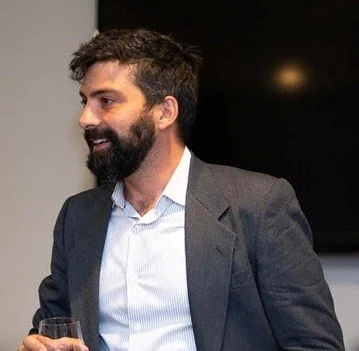
The Summer Seminars in Neuroscience and Philosophy (SSNAP), which I co-direct with my friend and colleague Walter Sinnott-Armstrong, would be my top choice. I love that program, and I feel that it has helped to improve the interactions between philosophers and neuroscientists a great deal. Second, my current and former students. I have been unbelievably lucky to have the chance to work with some of the best graduate students in the world, and there is nothing in my academic career I feel happier than the accomplishments of the members of my lab. Finally—and this is probably the nerdiest of all possible answers—there is one experimental paradigm I developed very early in my time at Duke (actually, I started working on it while at Harvard, so I am cheating a bit) that helps us understand how learning categorical information can subsequently influence true and false memories about exemplars of the learned category. I really liked that experimental paradigm, and I feel that it helped me to clearly show how our past experiences can bias the way in which our memories are reconstructed at retrieval.
What do you do for fun?
I play boardgames a lot. I have a group of good friends with whom I play every Thursday evening. We call ourselves the “Tarheel Tabletop Titans”. I also play D&D most Sundays. And I love to cook, to run, and to hike with my family.
D&D? You strike me as a bard-type?
Haha! I actually don’t think I’ve ever played a bard! I was a dual-class druid and ranger, for many years (twice as many, given I was multi-class, lol), and got to like level 15 or something ridiculous--in second edition, which was even harder. In the past 6 years or so, I’ve played a couple of campaigns, first as a gnome illusionist called Gotlob Grefe, and currently as an aasimar (which is kind of an angel) cleric with a profound desire to avenge the injustices suffered by his ancestors. I guess I just like casting spells!
So, do you miss home?
Home is where my family is, so home is here now. But I do miss lots of aspects of Colombia, particularly the part of my family that lives there. Thankfully, I get to go often.
Given your focus on memory, how has your research affected your understanding and relationship to your own memories?
You learn to appreciate both the wonders of its reliability and the normality of its fallibility. I enjoy many of the feelings elicited when reminiscing: nostalgia, melancholia, and the sheer joy of reenacting, even if just mentally, a cherished past experience. Likewise, I’ve become more forgiving of my memory errors. I laugh now at the occasional false recollection, and comfort myself in the fact that, when I cannot recall someone’s name or some fact I knew before, it need not be because my memories are decaying—although they probably are--but because of the tumultuous interference created by all the stuff I’ve read and experienced in-between.
How do you think your work intersects with other fields—politics, for example?
Memory is so essential to so many aspects of our life that it is hard to find an area it does not intersect with. Although, personally, I have only explored some of these intersections—for instance, the relationship between memory and counterfactual thinking, forgiveness, and moral judgment—I know that others have explored some of these ideas in relation to historical reconstruction and narrative versions of the self. A theory of memory that advocates for genuine recollection while at the same time allowing for a notion of accuracy that is less strict than the impossibly faithful standard of traditional philosophical accounts of remembering, becomes attractive—I think—for theorists interested in the fact that our historical and personal narratives are, too, reconstructed.
Do you ever think about the metaphysics of memory? Like what grounds the truth of memory claims, or whether the past or possible worlds are real?
Sometimes, yes, but not too often. Partly because I tend to think that whether an assertion is true is independent of our views as to what makes it true—i.e., what its truth-maker is (here the work of my friend and former roommate, philosopher Jamin Asay, has been quite influential in my thinking). In general, I tend to be a deflationist about truth and often feel no reason to draw serious ontological conclusions from true assertions, even when they include existential quantification. This is one of those Quinean lessons I used to believe in but no longer do. Thus, I am perfectly happy to accept that a memory report may be true, that it may refer to something that did happen in the past, and yet feel no need to say anything about the ontological reality of its truth-maker.
But you must think about philosophy of time…from time to time, no?
I often do, for sure. For instance, I am curious about the temporal dimension of our mental life. The mental contents we entertain when we are conscious of them last for a certain amount of time and take time to be deployed. But how long? Do all thoughts we entertain in our ‘spacious present’, as William James called it, take the same amount of time to be deployed or do they vary in terms of temporal length? And, if so, why? These questions about temporal individuation of mental contents intrigue me.
I am also very curious about the role of the hippocampus—which is an area of the brain that is critical for both episodic memory and spatial navigation—in enabling mental contents to be consciously deployed in time. In my own work I’ve hypothesized that individuals with hippocampal amnesia, such as the famous case of H.M., haven’t really “lost their memories”, but rather have lost their capacity to reconstruct stored episodic information in mental simulations that are consciously deployed through time.
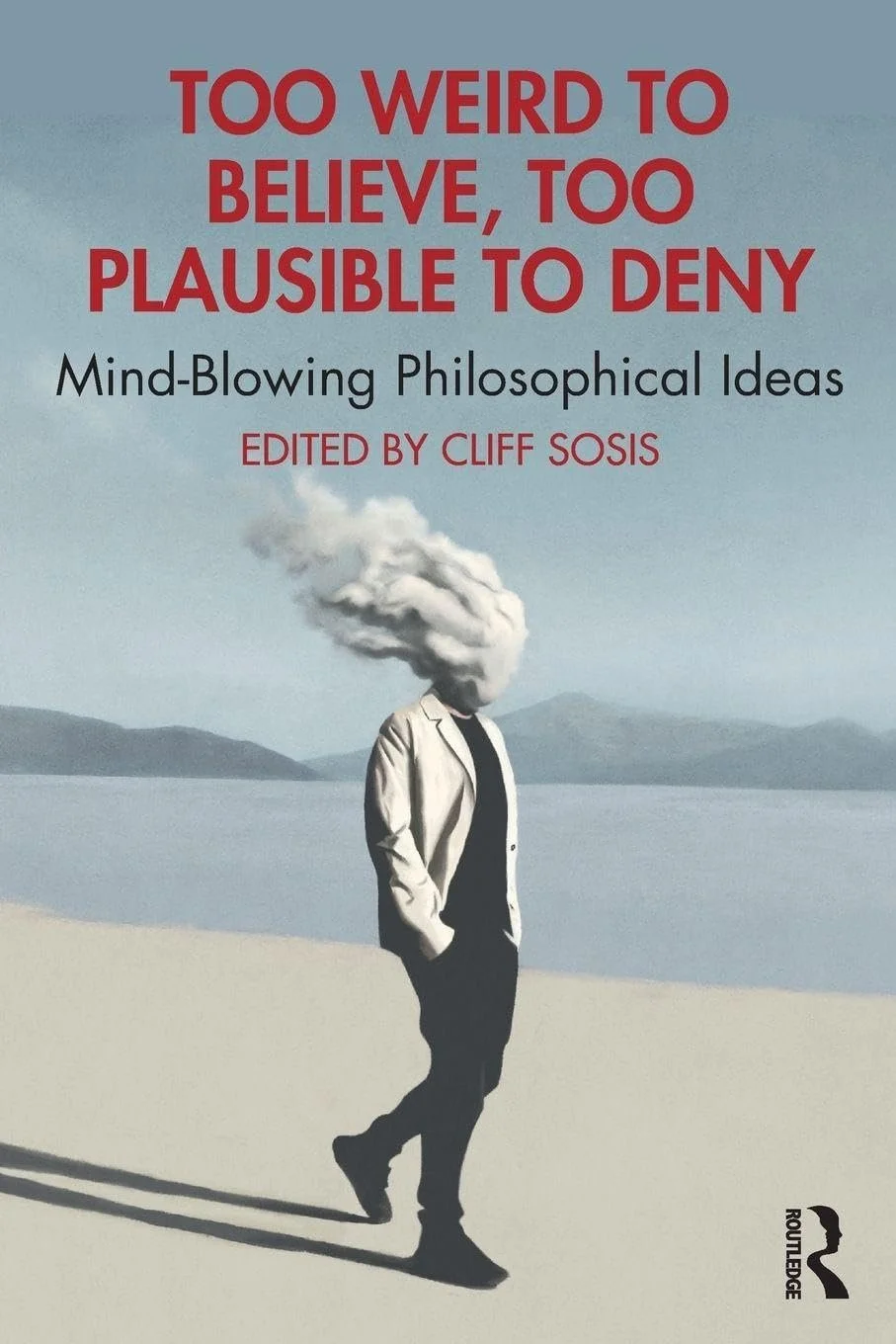
You contributed to my new book, Too Weird to Believe, Too Plausible to Deny! Tell the people a little bit about the stuff you discuss in the book. Interested in returning to those questions?
Yes, thanks for inviting me to contribute! My contribution is based on an old paper of mine, which I wrote while in grad school—it started as a final paper for Josh Knobe, I remember, so it must have been in my second year. We read bits of Nozick, including the thought-experiment of the experience machine. I had never read Nozick before and was not acquainted with the experience machine thought-experiment, but when I first read it, I thought it was utterly unintuitive. I remember thinking that, throughout my life, I had met lots of people that constantly sought to abandon reality, via drugs, videogames, or simply by going away. My knee-jerk reaction was that you’d only prefer to stay in the real world rather than connect to the experience-machine if either your real-world situation is overall pretty good and/or if you calculate that the reward of plugging in and experiencing something new outweighs the costs of abandoning a life you know. Thus, I decided to experimentally manipulate the alleged independent variable—the value for reality—by controlling for status quo, so I created these matrix-like vignettes in which participants were invited to think that they were connected to an experience machine by mistake, and that they were asked to choose if they wanted to disconnect or remain connected. If people really valued reality over virtual experiences, then you should see people overwhelmingly choosing to disconnect. But that’s not what you see. Instead, most participants wanted to remain connected. You can shift those percentages a bit if you make their real life very attractive, and thus you get a few more people willing to disconnect. By contrast, if their real life is pretty grim and sad, the overwhelming majority prefer to remain connected. I interpreted those results as conforming to the pattern you’d expect from the so-called “status quo bias”, a well-known psychological tendency to prefer the situation you are familiar with over unfamiliar ones.
Other researchers have replicated and developed these ideas further, and for a little while I read some of those papers—including those that were critical of my whole approach. However, my research since has taken me through different paths. It was fun to be invited to contribute to your volume, because it allowed me to think and read about the experience-machine again!
What are you working on now? Any projects you’re especially excited about?
I have several ongoing projects, but perhaps the main one is the work my team and I are doing in Colombia for the Memory and Forgiveness project. The purpose of that project, which started about 5 years ago, is to explore the relationship between memory and forgiveness in direct victims of political violence in Colombia. Based upon prior work from our lab, in which we have explored how imagination—particularly, counterfactual thinking—can help to modify the affective content of negative memories at retrieval in individuals with anxious ruminative thinking, I started to think of forgiveness as a psychological process that involves similar emotional reappraisal mechanisms. I didn’t know much about forgiveness at the time, but I was very lucky to join forces with two good friends: philosopher Santiago Amaya, who holds a similar view about forgiveness, and political scientist Pablo Abitbol, who has been working with victims of the Colombian conflict for decades. We teamed up to explore whether direct victims of guerrillas and paramilitaries do in fact change their affective reactions when remembering past wrongdoings as a function of whether they have forgiven the perpetrators.
Forgiveness is a very complex phenomenon, and a lot of the philosophical work on forgiveness assumes a bunch of stuff that does not hold in complex situations like the internal war in Colombia. For instance, a lot of work in philosophy assumes that the goal of forgiveness is to repair an existing relationship between two individuals—the victim and the perpetrator—but in the violent context of Colombia you often find that the perpetrator is not the person who’s asking for forgiveness, but rather, say, the commander of the battalion that perpetrated a certain massacre. Moreover, often the victim and the perpetrator didn’t even know each other, nor do they plan to have a relationship afterwards. Anyways, as it happens with philosophical examples, they tend to be oversimplified. I wanted to explore forgiveness in real, complex situations, and I have learned a lot. I look forward to continuing exploring the collected data in the months to come, and to continue thinking deeply about the relationship between memory and forgiveness.
Are you someone who forgives easily?
I guess it depends on what you mean by “forgives”. I don’t think I am someone that holds grudges, but I think that not holding a grudge is not the same as forgiving. There are some people in my life that have wronged me or have wronged my loved ones, and against whom I hold no grudges, but whose offenses I have not forgiven. I feel that, on some of those occasions, forgiveness could be possible, even easy, if the perpetrator were to apologize, or if it was clear that they would seek redemption or atonement. Forgiveness is often (but not always) relational and requires not only the victim to overcome feelings of resentment, but also the perpetrator to show remorse and demonstrate that they care about restoring the broken relationship, if there was one to begin with. I also believe that some offenses are unforgivable, even if one can somewhat easily “let go” and relinquish feelings of revenge and overcome resentment toward the perpetrators.
Which memories would you preserve forever if you could? Like I hope I remember all of the wonderful moments with my kid, and the idea I'm going to forget a lot of them kills me.
There are lots I’d love to preserve, vividly and forever. I can think of dozens of examples with my wife and kids. In fact, I often purposefully make myself remember many of these happy experiences so as to strengthen them in my memory. These days, I’ve been rehearsing in my mind lots of experiences with my sister, who tragically passed away recently, in order to keep my memories of her fresh and vivid.
If you could erase one of your own memories, would you? If you don’t mind sharing, what would it be?
I don’t think I’d like to erase any of them, not because I don’t have painful memories—I do—but because I think they have helped to shape my identity into the person I am now.
Which philosophers do you admire—or envy?
There are lots of living philosophers whose work I admire! Off the top of my head, in philosophy of mind, I can think of Frankie Egan, Peter Godfrey-Smith, Ian Phillips, Nick Shea, and Zina Ward. Outside of my area, there are others whose work I find beautifully insightful, including Zena Hitz—I loved Lost in Thought—Helen Longino and Lucy Allais.
What is stopping philosophy not disappearing, but simply being absorbed by other departments over the next 30 years? Where do you see philosophy in 30 years?
I don’t think philosophy would disappear even if philosophy departments were absorbed by other academic branches, and even if such absorption were to occur in countries outside of the US—which I doubt even more. Not only because there is philosophy outside of academia, but also because you can find philosophers outside of philosophy departments as well. At Duke, for instance, I know colleagues who work on issues in biology or statistics that are squarely philosophical, even though they publish in journals that academic philosophers wouldn’t recognize as philosophical. This may surprise a few readers, but philosophy is really important in many countries outside of the US. In Colombia, for instance, philosophy is mandatory in the last two years of high school, and as long as this continues to be the case, my guess is that there will be philosophy departments where future high school teachers can be trained. I venture that as long as there are countries that value education, and as long as there are universities that want to inspire their students to love and value knowledge for its own sake—as opposed to merely as a means to obtain capital—there will always be philosophy.
Favorite movies?
Karakter, by Mike van Diem. It’s a Dutch-Belgian movie from 1997. I also really liked the original Mildred Pierce, from 1945, with Joan Crawford. She’s phenomenal in that movie.
Books?
I read a lot, and a lot of fiction, so it is hard for me to pick one favorite book. But I have loved pretty much every book by Margarie Yourcenar and Kazuo Ishiguro.
TV shows?
I don’t watch a lot of TV, but I’d say “The Wire”.
You're married? How'd y'all meet?
Yes, I am. We met 20 years ago, at a Halloween party at the house of a mutual friend in Carborro, NC.
What would your wife say is your most annoying attribute?
Probably, the fact that I often forget to add events to our family calendar. But I am working on it.
You have kids? Does philosophy inform your parenting? Does parenting inform your philosophizing?
I do, and I love being a dad. Or, more precisely, I love being their dad. I am not sure if this is philosophy informing my parenting, but I certainly enjoyed quite a bit the sometimes-strange questions my children asked when they were little. Also, reading to my daughter some of my papers at night turned out to be a great strategy to help her to go to sleep. And they certainly inform my philosophizing quite a bit! They are a never-ending source of lessons and useful examples.
As an immigrant, how disturbed are you by shifting attitudes towards immigration in the states? Are you scared you might be targeted?
Disturbed and saddened. I think that the MAGA movement uncovered and catalyzed a brewing xenophobia I did not experience when I moved here, 23 years ago. In one of my first experiences as a TA in the US, I remember getting a student evaluation at the end of the year that complained about my accent. In the comments, this student wrote that I had too strong of an accent, and that I should probably consider doing something other than teaching and giving lectures. I was disheartened and shared this evaluation with one of my classmates, who immediately told me that I shouldn’t pay attention: that when people hear I have an accent, what they are thinking is that I speak at least another language, and they don’t. “It is probably envy”, this classmate told me. But shortly after Trump was elected the first time, I stopped at a gas station to buy snacks. While I was talking to the cashier another customer overheard me and screamed: “Go back to your f*king country!”. I left the store, visibly shaken. Might it have been hate all along? Was my old classmate wrong?
Do I feel that I might be targeted? Well, I don’t think so, but I don’t feel as free or as safe as I used to. Even though I am a US citizen, I now carry my passport, and I feel at risk every time I come back to the country by myself. I feel, like many naturalized Americans that were born in certain regions, that this administration sees me as a second order citizen. The situation is also hard for my family, especially my kids, who are aware of all the innocent immigrants that are taken into custody, sometimes for weeks. Last month, for instance, I went to Minneapolis to give a talk at their fantastic center for philosophy of science, and right before I left my 10-year-old daughter, worried, asked me to please not speak in Spanish during my trip because “that’s where they capture Latinos”. So, there is that.
Thoughts on events in Venezuela? Worried something like that might happen in Colombia with Petro?
What happened in Venezuela in January of this year is really worrying, not only because it violated international law and the sovereignty of our neighbor country, but also because it revived the terrible interventionist role of the US in Latin America that, quite frankly, many of us hoped was a thing of the past. For most of the 20th century, the US meddled with basically every government in Latin America they didn’t like or could pose an economic obstacle to their ambitions in the area, and these interventions often brought about devastating consequences for those nations. It is true that the situation in Venezuela had been—and continues to be—dire and extremely difficult for their citizens, who have been suffering for at least 40 years the economic collapse of what was a prosperous country. Many may think that those difficulties started with Chávez’s “Bolivarian Revolution”, but Venezuela was in turmoil since at least the mid 1980s. People may not remember but while the oil money from the 60s and 70s was enriching the upper class, the lower classes suffered enormously, and once the oil boom ended, the country overall was poor and extraordinarily unequal. Remember that “El Caracazo”, a series of riots in which thousands of people protested against economic measures that disproportionately and negatively affected the poor, left over a thousand people dead—and that was in 1989, almost 10 years before Chavez became president.
I doubt that the same would happen in Colombia. For one, Colombia has been a huge ally of the US for a very long time. The US also injected an enormous amount of money to the country during the war against the drug cartels, and in many ways the goals of that “Plan Colombia” were fulfilled. Colombia is an extremely unequal country, don’t get me wrong, but economic inequality is not the financial measure that the US cares about: they care about GDP, exports/imports, etc., and on those measures, Colombia is doing just fine. Besides, Petro’s term is about to end, and the chances of the right getting back into power are very high. So, I am not worried that this will happen in Colombia any time soon—or at least I hope not.
What would your last meal be?
Bandeja Paisa, which is a typical Colombian dish. People should google it (and, if they can, taste it!). It’s amazing.
If you were a god and could redesign human memory, how would you modify it?
I think I’d leave it mostly as it is, to be honest. I’ve spend a substantial amount of my academic career arguing that a perfect memory—that is, a kind of cognitive faculty that could record every detail ever experienced to then bring back to mind an identical mental content at retrieval—is not only psychologically, biologically and likely metaphysically impossible, but also, if it were, it would completely affect the way we experience the world and ourselves. We wouldn’t be who we are if our memory wasn’t imperfect, just the way it is.
If you could ask an omniscient being one question and be guaranteed a truthful answer, what would you ask?
I know you probably want some kind of philosophically interesting question, but if I was in front of such a being, I’d probably ask them to reveal where the unidentified victims of the Colombian conflict are. In the many years that I have been working in Colombia, and particularly in the last five years working directly with the community of victims of political violence, it’s become patently clear that truth is essential for reconciliation, and nothing helps the process of forgiving more than knowing the truth, than knowing where the bodies of your loved ones are, or why certain events occurred.
Thanks Felipe!
[interviewer: Cliff Sosis]